
These are the sieving curves for 50, 75, and 100 nm NPN membranes. The 75 nm NPN 30 nm gold data point is just an estimate, since the membrane broke before enough filtrate could be collected for an absorbance measurement. However,…

Author: Karl Smith
Karl is the 'separations czar' for NRG. As a Biophysics Ph.D. Candidate, Karl has the responsibility of characterizing new membranes, modeling the unique physics of nanomembrane separations, and finding ways to apply pnc-Si technology to protein purification, nanofluidic transistors, and human hemodialysis. Karl graduated from Allegheny College in 2011 with a double major in English and Physics.
Karl’s Thesis
Hey all, Here’s my thesis: ksmith thesis I filmed the public portion of my defense and posted the video to youtube. I’m not leaving till the end of the week, and I’ll be back for a week in mid-May as well…
Posted in NRG
Partial Sieving Curves for 50 and 100 nm Thick NPN
The x-values are based on TEM images of the last populations of gold nanoparticles (I think. I can’t remember immediately when the fridge died on us). It’s probably worth re-doing that with the new gold vials. There’s still some work…
Posted in NRG
TEM images of dried gold solutions
For the modeling paper, I had to precisely quantify the distribution of gold nanoparticles in the BBI solutions. To do this, I dried the stock solutions of particles on TEM grids (I don’t know what chips I used, but I seem…
Assembling a Variant of Jirachai’s Microfluidic Device for ACEO
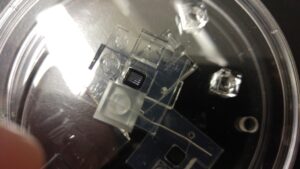
This blog post details how to assemble a variant of Jirachai’s microfluidic device (which looks like this): From its constituent parts (mostly this, two separate devices shown): Cutting the Gaskets You can find the template used to cut the 6…
Posted in NRG
(Almost) Final Versions of Model Paper Figures
We’re submitting the following paper to Separations and Purifications within the next two weeks: model-paper model supplement Below are the (almost) final versions of the figures from the paper. Figure 1: Schematic of Particle Distribution for Particles Rejected by Membranes…
Posted in NRG
Quick Characterization of 3D Printed Reverse Sepcons
Photo Courtesy J. Adam Fenster, U of R We’ve had several of each of the two prototype reverse Sepcon designs professionally 3D printed for us (top photo). I did a few quick tests to see how they worked in the…
Posted in NRG
Designing a Reverse-Centrifugation Sepcon Variant (Part 1: Geometry)
We have an STTR grant funding us to revise the Sepcon plastic housing to enable us to do reverse centrifugation easier. As outlined in this previous post, we’re trying to remove unbound IgG from a solution of IgG-antibody conjugates using…
Posted in NRG
Raw Data (including preliminary models) and Figure Drafts for the Modeling Paper
Below are drafts of all the figures I am planning on incorporating into my upcoming model paper. I believe I am done with data collection at this point. Data in figures not marked “NEW” probably needs to be updated. Note that all model…
Posted in NRG
The Need For SEPARATE Metal Films on the Front and Back of NPN Chips
It has been a constant theme in our EO efforts as well as our energy harvesting efforts that our electrodes need to be as close as possible to the surface to see an effect. In Jess’s early EO work, we…
Posted in NRG
