
First, a quick publication update. Recently we’ve published a paper on our efforts towards computationally analyzing polymorphonuclear leukocyte (PMN) trafficking on a vascular endothelium via hand-built µSiM flow cell devices. We record videos in phase contrast with a 40x objective…

Author: Dan Ahmad
Progress in Modelling Sepsis: Diminishing PMN chemotaxis towards fMLP gradients in µSiM Devices
Posted in NRG
Merging Man with Machine: A Computer Vision Aided Leukocyte Transmigration Assay
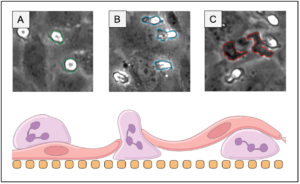
Introduction High throughput imaging techniques in conjunction with in vitro micro-physiological systems (MPS) allow for comprehensive exploration of physiologically relevant phenomena in a living 3D mimetic of a tissue microenvironment. Prior work in this lab has readily demonstrated that vascular…
Using Histogram Distance Measurements as a Means of Analyzing Flow Cytometry Data
Overview Recently, we performed a series of flow cytometry studies assessing neutrophil (PMN) activation in first generation flow devices. All the relevant data and can be found in a previous post: here. As part of the analysis, we chose to…
Assessing Neutrophil Activation inside a Flow Cell Device with Flow Cytometry
Introduction As part of our continuing evaluation of the flow cell developed by our collaborators at RIT, our next goal is to demonstrate that neutrophils remain inactivated when flown through a first generation device (Figure 1). For this, we studied…
Flow Cell/µSiM Testing – Push versus Pull Flow Modes
Introduction Static endothelial cell cultures have been routinely performed and optimized on the µSiM platform for multiple membrane and cell types. In order to increase the physiological relevance of our device with tissue vasculature mimetics, we need to incorporate fluid…
Monocyte Transmigration in μSiM Devices – Optimizing Microporosity for Future Studies
Introduction Infection or injury of tissue results in inflammatory signalling that motivates leukocyte recruitment to an inflamed location. Monocytes in particular are implicated in both pro inflammatory signalling through the M1 macrophage phenotype and regulation through the M2 macrophage phenotype.…
Monocyte Isolation via CD14+ Selection (Protocol)
Please see the attached .PDF file for a full monocyte isolation protocol. This is for isolating human monocytes from whole blood. Monocyte-Isolation-Protocol
QC on Dual Scale Membranes (Lot 1383)
Recently we have received dual scale (nanoporous and microporous) membranes from SiMPore at two porosities: 0.625% and 1.25%. These feature 3 µm circular pores (Lot 1383). We routinely perform QC checks on membrane deliveries, so the following is report on…
Posted in memBrains
Label Free State Analysis and Tracking: Neutrophils on HUVEC Monolayers
Introduction/Methods As part of our investigation into neutrophil transmigration on tissue chip systems featuring HUVEC monolayers, I have been working on developing code for both cell state analysis and tracking using Wolfram Mathematica (and occasionally Python). This project relies on…
Semantic Segmentation for Neutrophils on HUVEC Monolayers: A Machine Learning Approach
Introduction Phase-contrast microscopy is widely utilised in live cell imaging, with pixel segmentation protocols in particular finding widespread usage as a means to computationally isolate cells from a tissue-culture background. Computer segmentation allows for the analysis of individual cell properties…
