
Introduction The modular μSiM is based on a 96-well plate format with a 100 μl open well. While these devices have proven extremely useful for various barrier models including the blood-brain barrier1 and the tendon-vascular interface2, there is a need…

Category: hToC
Manufacturable Single-Slot Flow Insert Feasibility Testing
Introduction As discussed in a previous post, we are working to adapt a PDMS flow insert as a manufacturable component. While our priority was maintaining the original flow channel geometry as Mansouri et al. designed, we slightly changed the channel…
Manufacturable Single-Slot Flow Insert Update
Introduction A recent collaborative publication from RIT developed a modular µSiM to address the lack of physiological fluid flow in conventional open-well devices (Figure 1). The magnetic latching assembly of this design allows for quick configuration into a fluidic setup.…
Making the right connections: Testing new port connectors for flow applications

Introduction: Many applications of the µSiM require fluid to be continuously supplied to the microfluidic devices. We use laboratory tubing (typically Cole-Parmer/Tygon Tubing with I.D = 1/16″) that is connected to syringes or peristaltic pumps to do so. However, interfacing…
Merging Man with Machine: A Computer Vision Aided Leukocyte Transmigration Assay

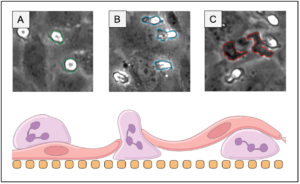
Introduction High throughput imaging techniques in conjunction with in vitro micro-physiological systems (MPS) allow for comprehensive exploration of physiologically relevant phenomena in a living 3D mimetic of a tissue microenvironment. Prior work in this lab has readily demonstrated that vascular…
Using Histogram Distance Measurements as a Means of Analyzing Flow Cytometry Data
Overview Recently, we performed a series of flow cytometry studies assessing neutrophil (PMN) activation in first generation flow devices. All the relevant data and can be found in a previous post: here. As part of the analysis, we chose to…
Assessing Neutrophil Activation inside a Flow Cell Device with Flow Cytometry
Introduction As part of our continuing evaluation of the flow cell developed by our collaborators at RIT, our next goal is to demonstrate that neutrophils remain inactivated when flown through a first generation device (Figure 1). For this, we studied…
Flow Cell/µSiM Testing – Push versus Pull Flow Modes
Introduction Static endothelial cell cultures have been routinely performed and optimized on the µSiM platform for multiple membrane and cell types. In order to increase the physiological relevance of our device with tissue vasculature mimetics, we need to incorporate fluid…
Monocyte Transmigration in μSiM Devices – Optimizing Microporosity for Future Studies
Introduction Infection or injury of tissue results in inflammatory signalling that motivates leukocyte recruitment to an inflamed location. Monocytes in particular are implicated in both pro inflammatory signalling through the M1 macrophage phenotype and regulation through the M2 macrophage phenotype.…
Monocyte Isolation via CD14+ Selection (Protocol)
Please see the attached .PDF file for a full monocyte isolation protocol. This is for isolating human monocytes from whole blood. Monocyte-Isolation-Protocol
