
20240605_LPW_MPS_Poster_Final

Category: μSiM
All things cell culture on the μSiM
Assessing the Permeability of Two Barriers in the Post-capillary Neurovascular Unit Part 2: Measuring R2

In Part 1 we explained that the composite barrier in our model of the post-capillary NVU is determined by RBBB = RBlB + R2 + RBrB where is R2 is the resistance of the ‘perivascular space’ in our chip. Unlike…
Posted in memBrains
The Journey to a Manufactured Flow Insert + Protocol for Use

Introduction The modular μSiM is based on a 96-well plate format with a 100 μl open well. While these devices have proven extremely useful for various barrier models including the blood-brain barrier1 and the tendon-vascular interface2, there is a need…
Effect of Tau on BMEC Monocultures in μSiMs (Rotation Project – Emily Reitz)

Introduction Alzheimer’s disease (AD) is a neurodegenerative disorder that is characterized by accumulation of amyloid beta (Aβ) peptides and neurofibrillary tangles (NFTs) made of aggregates of the protein tau (1,2). It results in the destruction of neurons and their connections…
Bacterial Inflammatory Stimulation of the μSiM-BBB Model
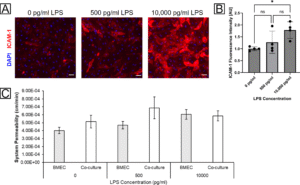
Introduction Sepsis refers to an uncontrolled systemic inflammatory response which can result from bacterial blood infections. We have long been interested in developing a sepsis model using the μSiM-BBB platform because the neuroinflammation stemming from sepsis can cause severe BBB…
Assessing the Permeability of Two Barriers in the Post-capillary Neurovascular Unit Part 1: The Problem Statement

The two barrier anatomy of the post-capillary NVU and why it matters At the post-capilliary venule, the blood-brain barrier (BBB) is actually two barriers in series: 1) one created by the pericyte/BMEC layer at the blood interface and 2) one…
Fc Receptor Binding Inhibitor Aggregation Issues in the CAD-LB Platform
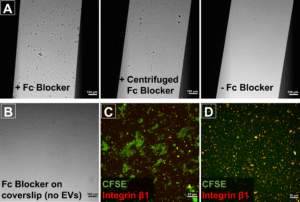
Introduction We are interested in exploring whether certain types of extracellular vesicles (EVs) may be more likely to become trapped while crossing the blood-brain barrier (BBB). Specifically, we are curious if EVs possessing certain types of surface integrins might bind…
Development of Arising Retinal Pigment Epithelium-19 (ARPE-19) Barrier Tissues on NPN

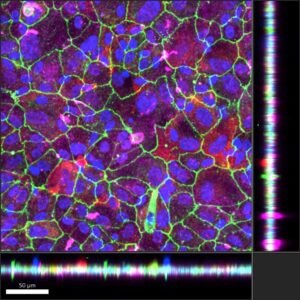
Author: Kevin Ling Dysfunction of the outer retinal blood barrier (oRBB), which is composed of the retinal pigment epithelium (RPE), Bruch’s membrane, and choriocapillaris (CC), is implicated in age-related macular degeneration (AMD), which causes irreversible central vision loss [1-4]. AMD…
Modification of Ultrathin Microporous Silicon Nitride Membrane Stiffness for Tissue Barrier Modeling

Introduction: Developing innovative therapeutics and treatment approaches with improved effectiveness and safety necessitates the use of cell co-culture models and barrier environments that mimic in vivo conditions. These models involve culturing two or more cell types together in vitro, allowing…
Using Dual-Scale Membranes as a Model for a ‘Leaky’ BBB

Introduction Many neurodegenerative diseases, including Alzheimer’s disease and Parkinson’s disease, are associated with an early breakdown of the blood brain barrier (BBB). This includes an increase in permeability and pericyte degradation [1]. We hypothesize that using dual-scale (nanoporous and microporous)…
Posted in memBrains
