
In Part 1 we explained that the composite barrier in our model of the post-capillary NVU is determined by RBBB = RBlB + R2 + RBrB where is R2 is the resistance of the ‘perivascular space’ in our chip. Unlike…

Category: memBrains
Assessing the Permeability of Two Barriers in the Post-capillary Neurovascular Unit Part 2: Measuring R2
Posted in memBrains
The Journey to a Manufactured Flow Insert + Protocol for Use

Introduction The modular μSiM is based on a 96-well plate format with a 100 μl open well. While these devices have proven extremely useful for various barrier models including the blood-brain barrier1 and the tendon-vascular interface2, there is a need…
Effect of Tau on BMEC Monocultures in μSiMs (Rotation Project – Emily Reitz)

Introduction Alzheimer’s disease (AD) is a neurodegenerative disorder that is characterized by accumulation of amyloid beta (Aβ) peptides and neurofibrillary tangles (NFTs) made of aggregates of the protein tau (1,2). It results in the destruction of neurons and their connections…
Bacterial Inflammatory Stimulation of the μSiM-BBB Model

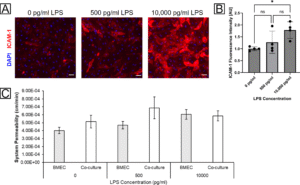
Introduction Sepsis refers to an uncontrolled systemic inflammatory response which can result from bacterial blood infections. We have long been interested in developing a sepsis model using the μSiM-BBB platform because the neuroinflammation stemming from sepsis can cause severe BBB…
Assessing the Permeability of Two Barriers in the Post-capillary Neurovascular Unit Part 1: The Problem Statement

The two barrier anatomy of the post-capillary NVU and why it matters At the post-capilliary venule, the blood-brain barrier (BBB) is actually two barriers in series: 1) one created by the pericyte/BMEC layer at the blood interface and 2) one…
Using Dual-Scale Membranes as a Model for a ‘Leaky’ BBB

Introduction Many neurodegenerative diseases, including Alzheimer’s disease and Parkinson’s disease, are associated with an early breakdown of the blood brain barrier (BBB). This includes an increase in permeability and pericyte degradation [1]. We hypothesize that using dual-scale (nanoporous and microporous)…
Posted in memBrains
Manufacturable Single-Slot Flow Insert Feasibility Testing
Introduction As discussed in a previous post, we are working to adapt a PDMS flow insert as a manufacturable component. While our priority was maintaining the original flow channel geometry as Mansouri et al. designed, we slightly changed the channel…
Manufacturable Single-Slot Flow Insert Update
Introduction A recent collaborative publication from RIT developed a modular µSiM to address the lack of physiological fluid flow in conventional open-well devices (Figure 1). The magnetic latching assembly of this design allows for quick configuration into a fluidic setup.…
Making the right connections: Testing new port connectors for flow applications

Introduction: Many applications of the µSiM require fluid to be continuously supplied to the microfluidic devices. We use laboratory tubing (typically Cole-Parmer/Tygon Tubing with I.D = 1/16″) that is connected to syringes or peristaltic pumps to do so. However, interfacing…
Localizing Basement Membrane Production in Coculture BBB Model

Introduction The basement membrane (BM) is a critical component of a healthy blood-brain barrier (BBB) model. Further, the BM breaks down in several diseases. Both pericytes and endothelial cells can contribute to basement membrane production. This post will explore a…
