Author: Louis Widom

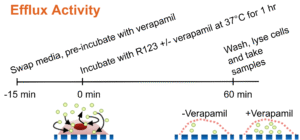
IMR90 EECM-BMEC-Like Cells Lack P-gp Efflux Activity

Introduction During the January TraCe-bMPS progress meeting, Jon Flax presented some interesting findings in the iPSC-derived extended endothelial culture method brain microvascular endothelial cell-like cells (EECM-BMECs, hereafter referred to as BMECs) [1]. While these BMECs tended to have high expression

Posted in TRACE

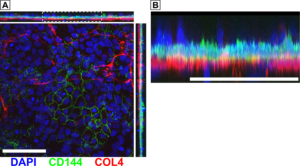
Pericytes Contribute Basement Membrane Proteins in a Human Stem Cell-Derived Blood-Brain Barrier Model (Louis Widom’s 2024 MPS World Summit Poster)

20240605_LPW_MPS_Poster_Final

Posted in NRG, μSiM

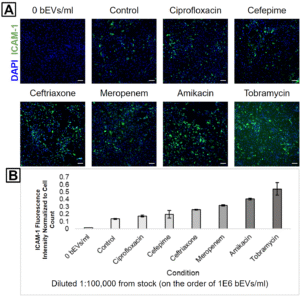
HUVEC ICAM-1 Activation by Bacterial Extracellular Vesicles Derived From E. coli Treated with Different Antibiotics

Introduction In prior work by Panteha Torabian and the Michel Lab (RIT’s College of Science), we have seen that treatment of E. coli with different antibiotics can result in changes in the production of bacterial extracellular vesicles (bEVs). In the

Posted in NRG Tagged with: , , ,

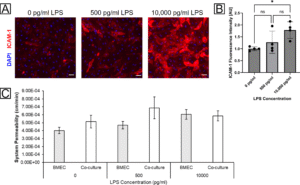
Bacterial Inflammatory Stimulation of the μSiM-BBB Model

Introduction Sepsis refers to an uncontrolled systemic inflammatory response which can result from bacterial blood infections. We have long been interested in developing a sepsis model using the μSiM-BBB platform because the neuroinflammation stemming from sepsis can cause severe BBB

Posted in memBrains, NRG, μSiM

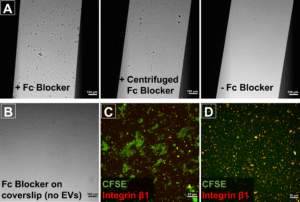
Fc Receptor Binding Inhibitor Aggregation Issues in the CAD-LB Platform

Introduction We are interested in exploring whether certain types of extracellular vesicles (EVs) may be more likely to become trapped while crossing the blood-brain barrier (BBB). Specifically, we are curious if EVs possessing certain types of surface integrins might bind

Posted in NRG, μSiM, μSiM-DX

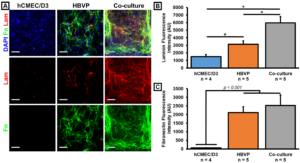
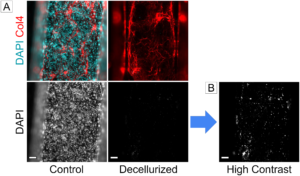
Fibronectin and Friends: Confirming the Presence of Multiple Vascular Basement Membrane Components in the μSiM-hNVU

Introduction The blood-brain barrier (BBB) plays an important role in maintaining brain chemistry by restricting the permeability of small molecules and cells. Inflammatory diseases may disrupt the BBB and promote the development of neurological disorders [1]. One potential mechanism of

Posted in memBrains, NRG, μSiM

Updates on Modeling the Vascular Basement Membrane in the μSiM-hNVU

Introduction The blood-brain barrier (BBB) plays an important role in maintaining brain chemistry by restricting the permeability of small molecules and cells. Inflammatory diseases may disrupt the BBB and promote the development of neurological disorders [1]. One potential mechanism of

Posted in memBrains, NRG, μSiM

Progress Toward Modeling Inflammation-Mediated Degradation of Basement Membrane Proteins in the μSiM-hNVU

Introduction The blood-brain barrier (BBB) plays an important role in maintaining brain chemistry by restricting the permeability of small molecules and cells. Inflammatory diseases may disrupt the BBB and promote the development of neurological disorders [1]. One potential mechanism of

Posted in memBrains, NRG, μSiM

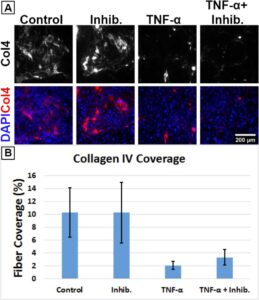
Basement Membrane Disruption by Tumor Necrosis Factor-α in the μSiM-hNVU

Note: a postscript regarding an assay to determine the activity of our MMP-2/MMP-9 inhibitor was added to this post on June 14, 2021. Introduction The blood-brain barrier (BBB) plays an important role in maintaining brain chemistry by restricting the permeability

Posted in memBrains, NRG, μSiM

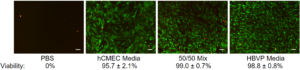
Human brain vascular pericyte viability in endothelial media

Introduction Mural cells, including smooth muscle cells and pericytes, are important for supporting endothelial cells in the vasculature [1]. They play a role in angiogenesis, and contribute to the development of the vascular basement membrane that provides structure for blood

Posted in memBrains, NRG
0
    0
    Your Cart
    Your cart is emptyReturn to Shop