
Category: μSiM-DX

Use of the µSiM in a diagnostics application

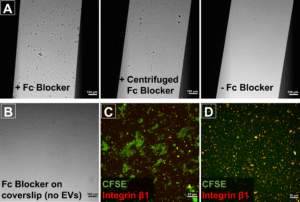
Fc Receptor Binding Inhibitor Aggregation Issues in the CAD-LB Platform

Introduction We are interested in exploring whether certain types of extracellular vesicles (EVs) may be more likely to become trapped while crossing the blood-brain barrier (BBB). Specifically, we are curious if EVs possessing certain types of surface integrins might bind

Posted in NRG, μSiM, μSiM-DX

CAD-IA update: GFAP dose-dependency from its non-specific binding to beads

Introduction As what we’ve learned from the previous “Catch-and-Display Immunoassay” (CAD-IA) trials, we switched to an antibody pair from OriGene with low non-specific binding ability to each other and start to conduct ultracentrifugation for all reactive reagents for the reduction

Posted in NRG, μSiM-DX

EV Enrichment with Izon qEV Column

Introduction This post will describe the preliminary work I have completed using size exclusion chromatography (SEC) for EV enrichment. We are ultimately interested in interrogating serum EV biomarkers using CAD-LB, however, the presence of protein and lipoprotein contaminants reduces the

Posted in NRG, μSiM-DX

Exploring Urinary EV Detection Using CAD-LB

Introduction This post provides an update on a series of experiments conducted with Sam. These experiments were designed to assess the versatility of the CAD-LB platform for detecting EVs in urine samples. Urine is a complex biofluid often used in

Posted in NRG, μSiM-DX

CAD-LB: Biomarker Detection Validation – ICAM-1 HUVEC Stimulation Model

Introduction This post is another update in my series of experiments aiming to both characterize and validate the CAD-LB platform. We have now shifted our focus to validating CAD-LB biomarker detection which will be done using multiple experimental models. The

Posted in NRG, μSiM-DX

CAD-LB: Colocalization Detection Guide

Introduction In this post I will review work I have completed to further characterize the CAD-LB platform. In this set of experiments combinations of nanoparticle species were used to define colocalization limitations. More specifically, two nanoparticle species each labeled with

Posted in NRG, μSiM-DX

Characterization of the CAD-LB: Dynamic Range & Capture Efficiency

Introduction This post is meant to serve as an update for some of the more recent work completed on the CAD-LB (catch and display for liquid biopsy) platform. The CAD-LB is intended to be used as a digital biomarker assay

Posted in μSiM, μSiM-DX

Strutting the Runway: Modeling the Microfluidics and Reaction Kinetics of the μSiM-DX

The development of the μSiM-DX has been swift and focused, as discussed in these previous blog posts: https://trace-bmps.org/beadazzled-laying-the-foundation-of-the-%ce%bcsim-dx-fouling-based-sensor/ and https://trace-bmps.org/vindictive-virus-capture-testing-the-%ce%bcsim-dx-with-vaccinia-virus-towards-a-modular-virus-diagnostic/. To provide a greater understanding of the inner workings of the device, I have done a few calculations regarding some of

Posted in NRG, μSiM-DX

Vindictive Virus Capture: Testing the μSiM-DX with Vaccinia Virus Towards a Modular Virus Diagnostic

After completing proof of concept testing with polystyrene beads and with the goal of creating a SARS-CoV-2 sensor (Discussed in this post: https://trace-bmps.org/beadazzled-laying-the-foundation-of-the-%ce%bcsim-dx-fouling-based-sensor/), we sought to test the performance of the system with a target more similar to the SARS-CoV-2

Posted in NRG, μSiM-DX

Beadazzled: Laying the Foundation of the μSiM-DX Fouling-based Sensor

Starting in December of 2019, we began capturing fluorescent beads on microslit silicon nanomembranes as an illustrative representation of particle capture within our microfluidic devices. From then until now we have successfully used this method within gasket made TFAC devices

Posted in NRG, μSiM-DX
0
    0
    Your Cart
    Your cart is emptyReturn to Shop