
I would like to share a collection of high resolution SEM images of nanopores of polycarbonate track-etch (PCTE) membrane. These nanopores have very high pore length-to-diameter aspect ratio of 6000 nm / 25 nm. I hope you find them useful.…

Category: NRG
MgF2 Nanomembrane Fabrication on partially etched NPN substrates

This work is a continuation of my last post, Partial Etch RIE Blows out NPN Pores, where I take the process a step further and deposit MgF2 onto the newly opened substrates. I used the same etch recipe to blow out…
Posted in NRG
SLAS 2017 Conference Recap

SLAS – Society for Laboratory Automation and Screening https://www.slas.org Annual Conference February 6-8, 2017 in Washington DC Attended by Tom Gaborski for informative purposes. Collaborators/colleagues in attendance: Vinay Abhankar (UT-Arlington), Andrea Mazzocchi (alum @ Wake Forest), August Allen (alum @…
Posted in NRG
Assembling a Variant of Jirachai’s Microfluidic Device for ACEO

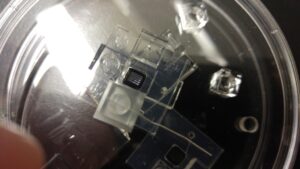
This blog post details how to assemble a variant of Jirachai’s microfluidic device (which looks like this): From its constituent parts (mostly this, two separate devices shown): Cutting the Gaskets You can find the template used to cut the 6…
Posted in NRG
Separation of Microbeads from Whole Blood on 8 and 9 Micron Slit Membranes

A few weeks ago, Josh and JP brought me some 3 window microslit membranes that had edge aligned 8 and 9 μm slits. While these may seem to be quite large for most applications, they are in fact perfect for working…
Posted in NRG
Sacrificial releasing layer and SU-8, plans

This post summarizes a quick update on 2 different goals: 1) membrane releasing and 2) SU-8 strain reduction. Here you will find basic background on some of the work that has already been conducted and the planned experimental work that…
Posted in NRG
HUVEC migration and Fibronectin Fibrillogenesis

Intro: Hi all, as we investigate the formation of HUVEC focal adhesions on porous SiO2 membrane , we also looked at fibronectin fibriollogenesis. Interestingly, it appears that after 24 hr (since the initial seeding), the fibronectin fibrils formed by HUVEC vary…
Posted in NRG
(Almost) Final Versions of Model Paper Figures
We’re submitting the following paper to Separations and Purifications within the next two weeks: model-paper model supplement Below are the (almost) final versions of the figures from the paper. Figure 1: Schematic of Particle Distribution for Particles Rejected by Membranes…
Posted in NRG
Partial Etch RIE Blows out NPN Pores
As the title states, this post is about shifting an arbitrary pore distribution in an NPN layer. Why would we want to do this? We believe that the underlying pore distribution and shape influences the properties of many of our…
Posted in NRG
Final Update over TE membrane

Hello Everyone, So first of all, a quick reminder of what i have been working on: we were able to show the trapping of the beads by TE membranes, although in final step and after releasing of the beads,…
Posted in NRG
