
Introduction When searching for a flow control system for microfluidic cell culture, we look to balance the ease of use, accessibility, and precision of fluidic control. For instance, researchers have explored different powered actuation methods for miniaturized precise proportional fluid…

Category: memBrains
R61/R33 Update to NIH on Nov. 9, 2022

Attached is a PDF presented to the NIH at our annual update meeting that included other funded project teams. R61_R33HL154249 11-22 Update (Low Res)
Posted in memBrains
Development of a TEER module for barrier tissue characterization
Introduction Tissue barriers separate different compartments of body organs. These barriers regulate the absorption of nutrients, maintain homeostasis, and prevent toxins from entering. In vitro models of tissue barriers have been developed to understand human diseases and investigate drug toxicity…
Culture of iPSC-BMECs at RIT

Introduction The capability of the m-μSiM for establishing an hiPSC-derived blood-brain barrier (BBB) in bioengineering and bioscience laboratories has been shown previously [1]. To further demonstrate interlaboratory agreement and successful dissemination of components and protocols, m-μSiM was used at RIT…
Gene expression analysis of HUVECs cultured on uSiM (static vs flow)
Introduction Studies have shown that the shear-stimulation of endothelial cells results in the upregulation of the shear-sensitive transcription factor Kruppel-like factor 2 (KLF2). KLF2 plays a critical role in the regulation of endothelial activity such as the regulation of vascular…
High Throughput Multiplexed Digital-Molecular-Counting Blood-Brain-Barrier on a Chip System (dμSIM plate)

Background Tissue-on-a-chip systems have been a promising means of mimicking and understanding the complex and convoluted functions of the in vivo blood-brain barrier (BBB). These semipermeable borders of endothelial cells are highly selective in order to protect the fragile central…
Posted in memBrains
Fibronectin and Friends: Confirming the Presence of Multiple Vascular Basement Membrane Components in the μSiM-hNVU

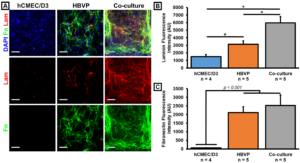
Introduction The blood-brain barrier (BBB) plays an important role in maintaining brain chemistry by restricting the permeability of small molecules and cells. Inflammatory diseases may disrupt the BBB and promote the development of neurological disorders [1]. One potential mechanism of…
Optimizing Cytomix Stimulation on Mono- and Coculture BBB Models

Introduction The µSiM BBB model is being developed at UR with the goal to understand the impact of sepsis on the brain. Here, we use an EECM-BMEC-like cell (iSPC-derived brain endothelial cells) [1] monoculture model and an EECM-BMEC-like cell and…
Merging Man with Machine: A Computer Vision Aided Leukocyte Transmigration Assay

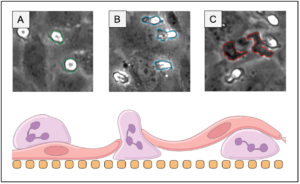
Introduction High throughput imaging techniques in conjunction with in vitro micro-physiological systems (MPS) allow for comprehensive exploration of physiologically relevant phenomena in a living 3D mimetic of a tissue microenvironment. Prior work in this lab has readily demonstrated that vascular…
Updates on Modeling the Vascular Basement Membrane in the μSiM-hNVU
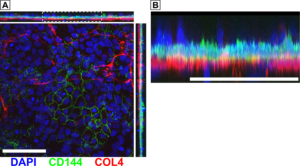
Introduction The blood-brain barrier (BBB) plays an important role in maintaining brain chemistry by restricting the permeability of small molecules and cells. Inflammatory diseases may disrupt the BBB and promote the development of neurological disorders [1]. One potential mechanism of…
