
Category: μSiM

All things cell culture on the μSiM

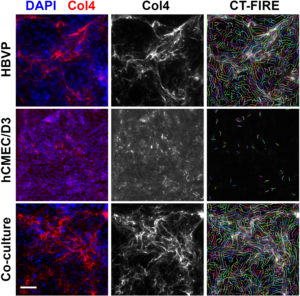
Collagen IV deposition by hCMEC/D3 (endothelial cell) and HBVP (pericyte) co-cultures in the μSiM-hNVU

Note: A postscript regarding a gelatin assay to determine MMP-9 activity was added to this post on Feb 25, 2021. Introduction The blood-brain barrier (BBB) plays an important role in maintaining brain chemistry by restricting the permeability of undesirable small

Posted in memBrains, NRG, μSiM

Introduction of beads into the flow module

1. Introduction Fluid flow is one of the key elements of vascular models for delivering nutrients and growth factors to cells as well as introducing other components like neutrophils. In post 1, we described our modular design for incorporating a

Posted in memBrains

Monolayer Culture of mouse CMECs on μSIM A-Line Devices

Introduction In the Glading Lab we study a rare disease called Cerebral Cavernous Malformations (CCMs). In this disease, brain capillaries develop greatly enlarged lumens and a disrupted blood-brain barrier. A genetic cause of the disease is the presence of a

Posted in memBrains, NRG, μSiM Tagged with: , , ,

Theoretical Underpinnings of Small Molecule Permeability Measurements in the µSiM (Part 2: Experimental Validation)

This is the second installment in a series of posts focused on the development of a method for measuring barrier permeability in the µSiM. In Part 1 we discussed the goal of making these measurements in situ at a position

Posted in memBrains, NRG, μSiM Tagged with:

hiPSC Differentiation into Brain Pericyte-like Cells, Round 2

Introduction Breakdown of the blood-brain barrier (BBB) is one of the earliest signs of sepsis and is linked with long-term cognitive impairment. As animal models poorly recapitulate human sepsis, alternative approaches are direly needed to understand sepsis-associated brain injury and

Posted in memBrains

HBVP (pericyte) and hCMEC/D3 (endothelial cell) µSiM Coculture Optimization

Introduction Breakdown of the blood-brain barrier (BBB) is one of the earliest signs of sepsis and is linked with long-term cognitive impairment. We are developing a coculture model of the human blood-brain barrier (µSiM-hBBB) to elucidate mechanisms of BBB breakdown

Posted in memBrains, NRG

iPSC IMR90-4 ApoE Genotyping

Introduction The ApoE4 allele of the apolipoprotein E (ApoE) gene is the greatest known genetic risk factor for Alzheimer’s disease. Further it has been linked to increased susceptibility and duration of infection. On the other hand, the ApoE3 allele has

Posted in memBrains

AFM studies on HUVECs in Aline Devices

Introduction Previous work was done on determining physical properties of the glycocalyx of endothelial cells, this was performed on glass inserts using the Asylum AFM.   We wanted to continue this testing using the Aline uSim devices in order to

Posted in memBrains, NRG, μSiM

Theoretical Underpinnings of Small Molecule Permeability Measurements in the µSiM (Part 1: Approach)

NOTE: Some of the ideas in this post are borrowed and rephrased from prior posts by Molly and Alec and our paper Khire et al. 2020. The purpose of this thread is to explain things anew with an eye on

Posted in memBrains, NRG Tagged with:

Multiplexed digital assay: mouse CCL2(MCP1) CXCL1(KC) panel development

Mouse CCL2/MCP1 and CXCL1/KC pre-equilibrium digital ELISA has been developed with the current dynamic range set to be 4-500pg/ml for CCL2/MCP1 and 8-1000pg/ml for CXCL1/KC. This initial dynamic range was selected by inferring from the ELISA kit reagent working concentration

Posted in memBrains
0
    0
    Your Cart
    Your cart is emptyReturn to Shop