
Introduction The modular μSiM is based on a 96-well plate format with a 100 μl open well. While these devices have proven extremely useful for various barrier models including the blood-brain barrier1 and the tendon-vascular interface2, there is a need…

Category: NRG
Effect of Tau on BMEC Monocultures in μSiMs (Rotation Project – Emily Reitz)

Introduction Alzheimer’s disease (AD) is a neurodegenerative disorder that is characterized by accumulation of amyloid beta (Aβ) peptides and neurofibrillary tangles (NFTs) made of aggregates of the protein tau (1,2). It results in the destruction of neurons and their connections…
μSlide to hold μSiM devices for enhanced imaging & fluidic applications

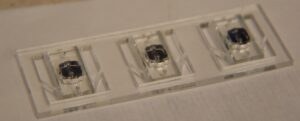
Introduction The Slide Body (Figure 1) has been used for a long time to image μSiM devices. This slide body has the same footprint as a traditional microscope slide but is designed to hold up to 2 μSim devices for…
Posted in NRG
Bacterial Inflammatory Stimulation of the μSiM-BBB Model

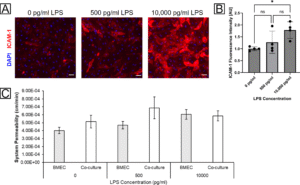
Introduction Sepsis refers to an uncontrolled systemic inflammatory response which can result from bacterial blood infections. We have long been interested in developing a sepsis model using the μSiM-BBB platform because the neuroinflammation stemming from sepsis can cause severe BBB…
Assessing the Permeability of Two Barriers in the Post-capillary Neurovascular Unit Part 1: The Problem Statement


The two barrier anatomy of the post-capillary NVU and why it matters At the post-capilliary venule, the blood-brain barrier (BBB) is actually two barriers in series: 1) one created by the pericyte/BMEC layer at the blood interface and 2) one…
History repeats itself: There’s something in the water

Dave Fang posted a poster in 2010 about particles found in DI water. I encountered the same issue during the nano-pocket permeability experiment. He said, “I’ve become increasingly suspicious of membrane clogging during the … permeability experiments.” I conducted an…
Posted in NRG
Fc Receptor Binding Inhibitor Aggregation Issues in the CAD-LB Platform
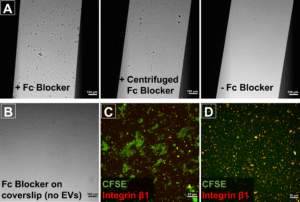
Introduction We are interested in exploring whether certain types of extracellular vesicles (EVs) may be more likely to become trapped while crossing the blood-brain barrier (BBB). Specifically, we are curious if EVs possessing certain types of surface integrins might bind…
CAD-IA update: GFAP dose-dependency from its non-specific binding to beads


Introduction As what we’ve learned from the previous “Catch-and-Display Immunoassay” (CAD-IA) trials, we switched to an antibody pair from OriGene with low non-specific binding ability to each other and start to conduct ultracentrifugation for all reactive reagents for the reduction…
Development of Arising Retinal Pigment Epithelium-19 (ARPE-19) Barrier Tissues on NPN

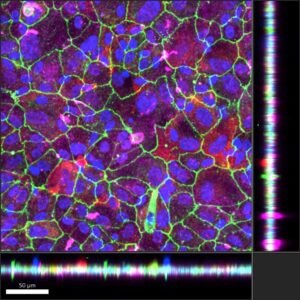
Author: Kevin Ling Dysfunction of the outer retinal blood barrier (oRBB), which is composed of the retinal pigment epithelium (RPE), Bruch’s membrane, and choriocapillaris (CC), is implicated in age-related macular degeneration (AMD), which causes irreversible central vision loss [1-4]. AMD…
Nano-pocket Membrane Pressure Modeling
Introduction: In the previous post, we demonstrated our capability to fabricate the nano-pocket membrane and effectively capture and release particles of various sizes. In this post, our focus shifts to exploring the membrane capability. We will focus on the membrane…
Posted in NRG
