
Introduction Breakdown of the blood-brain barrier (BBB) is one of the earliest signs of sepsis and is linked with long-term cognitive impairment. As animal models poorly recapitulate human sepsis, alternative approaches are direly needed to understand sepsis-associated brain injury and…

Category: NRG
Electron Beam Lithography Microchannel Fabrication

This post is a continuation of project found in Fabricating 0.5 um Channels in Microscope Slides for Staph Invasion Assays. Just to review, after the development of μSiM-CA (Canalicular Array; see Masters et al., Nanomedicine: Nanotechnology, Biology, and Medicine 2019),…
SPIE Photonics West BiOS Conference Presentation: Rapid detection of intact SARS-CoV-2 viral particles using silicon nanomembranes

This year we were invited to submit a manuscript and presentation to the SPIE Photonics West BiOS Conference. We submitted both on the work we have done on the uSIM-DX virus sensor platform. Below I have attached the presentation which…
Posted in NRG
Electrospinning aligned polymeric fibers on parylene stencils

The aim of this work was to electrospin aligned polymeric fibers on parylene stencils as means to characterize the critical necessary total area and necessary opening sizes to elicit endothelial cell response in the form of cell alignment among other…
Posted in NRG
Modification of parylene C/N membranes for altered cell-substrate interactions
The motivation of this work by Daniela Lincoln (master’s student) was to investigate the feasibility of using different variants of parylene (C and N) for barrier studies and to look deeper into the implications of plasma surface modification for cell-substrate…
Posted in NRG
Cell-substrate interaction modeling

The idea of this project started when we were writing a mini-review about cell-substrate interaction. Although most of studies of cellular responses to porous membranes have pointed towards a multiphasic response with the same trend of changes with respect to…
Posted in NRG
Collagen IV deposition by hCMEC/D3 (endothelial cell) and HBVP (pericyte) co-cultures in the μSiM-hNVU

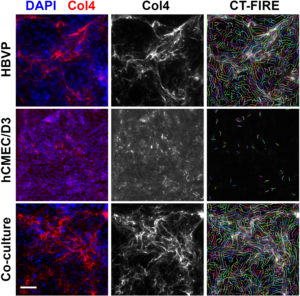
Note: A postscript regarding a gelatin assay to determine MMP-9 activity was added to this post on Feb 25, 2021. Introduction The blood-brain barrier (BBB) plays an important role in maintaining brain chemistry by restricting the permeability of undesirable small…
Fibroblast Wound Healing with EVs and EV Depleted Media

Introduction Previous experiments completed by Hayley Miller investigated the effect of small extracellular vesicles (EVs) collected from Adipose Derived Stem Cells (ADSCs) on wound closure velocity and cell speed. Her previous related post can be found here. It was initially…
Posted in NRG
Monolayer Culture of mouse CMECs on μSIM A-Line Devices

Introduction In the Glading Lab we study a rare disease called Cerebral Cavernous Malformations (CCMs). In this disease, brain capillaries develop greatly enlarged lumens and a disrupted blood-brain barrier. A genetic cause of the disease is the presence of a…
Theoretical Underpinnings of Small Molecule Permeability Measurements in the µSiM (Part 2: Experimental Validation)

This is the second installment in a series of posts focused on the development of a method for measuring barrier permeability in the µSiM. In Part 1 we discussed the goal of making these measurements in situ at a position…
