
Category: memBrains

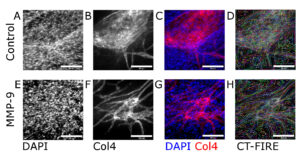
Measuring changes in endothelial basement membrane integrity

Introduction Inflammatory diseases have the potential to disrupt blood vessel permeability. This has serious ramifications for the blood-brain barrier (BBB), which is the interface between the vasculature and the brain. A healthy BBB allows essential nutrients to pass through while

Posted in memBrains, NRG

Label Free State Analysis and Tracking: Neutrophils on HUVEC Monolayers

Introduction/Methods As part of our investigation into neutrophil transmigration on tissue chip systems featuring HUVEC monolayers, I have been working on developing code for both cell state analysis and tracking using Wolfram Mathematica (and occasionally Python). This project relies on

Posted in hToC, memBrains

Semantic Segmentation for Neutrophils on HUVEC Monolayers: A Machine Learning Approach

Introduction Phase-contrast microscopy is widely utilised in live cell imaging, with pixel segmentation protocols in particular finding widespread usage as a means to computationally isolate cells from a tissue-culture background. Computer segmentation allows for the analysis of individual cell properties

Posted in hToC, memBrains

Phase Contrast Microscopy Image Correction for Neutrophil Transmigration Studies

Introduction Selective leukocyte interactions with endothelial barriers are a characteristic component of the inflammatory response process. These spatio-temporal interactions can mechanically remodel local tissue, as well as damage healthy tissue with robust inflammation stemming from an over-reactive immune response. This

Posted in hToC, memBrains

Maintaining Polarized Inflammation and ICAM-1 mAb Blocking – FINAL Polarized TNF-alpha Revision Experiments

Introduction Read the manuscript here: Integrative Biology Publication Please refer to the linked manuscript for a detailed introduction. In short, we have been interested in characterizing the role of endothelial cell (EC) apicobasal polarity in inflammation. While usually reserved for

Posted in memBrains, NRG

pedELISA sensing on diffusion limited cytokines in uSIM

IntroductionThe ability to continuously sample and assay for the levels of soluble factors without disrupting the microenvironment is important to acquire sequential secretion profiles in BBB experiments on an uSIM module. Combining small volume sampling, buffer replenishment and sensitive pedELISA

Posted in memBrains

Creating Unwanted Vacuoles in Endothelial Cells With Flow – Mossu et al – unpublished

Vacuoles with pulling flow vs pushing flow This video shows an example of the first trials with the uSim flow cell (Tejas’ early versions) when creating laminar flow over a monolayer of BLECs – see Mossu et al, JCBFM 2018

Posted in memBrains, NRG

10 kDa Small Molecule Permeability Optimization

Introduction A healthy blood-brain barrier is not permissive to most small molecules, but during inflammation, tight junctions weaken and the barrier becomes more permissive. We have developed an in situ permeability assay that tracks diffusion across a cell monolayer and

Posted in memBrains Tagged with:

Design and fabrication of the microfluidic flow module

Introduction Sepsis is a serious condition where unregulated systemic inflammation can cause organ failure and death. Recent evidence has also shown that sepsis can cause cognitive impairment in surviving patients. However, the mechanisms that cause sepsis-related damage to the brain

Posted in memBrains

Extended Endothelial cell Culture Method-differentiated Brain Microvascular Endothelial Cell-like cell (EECM-BMEC-like cell) growth on Dual-Scale Membranes

Introduction Human induced pluripotent stem cell (hiPSC)-derived blood-brain barrier (BBB) models have proven to be useful to study disease pathomechanisms and drug delivery into the central nervous system. Currently available hiPSC-derived BBB models are well characterized with respect to diffusion

Posted in memBrains
0
    0
    Your Cart
    Your cart is emptyReturn to Shop