
Introduction Studies have shown that the shear-stimulation of endothelial cells results in the upregulation of the shear-sensitive transcription factor Kruppel-like factor 2 (KLF2). KLF2 plays a critical role in the regulation of endothelial activity such as the regulation of vascular…

Category: μSiM
All things cell culture on the μSiM
High Throughput Multiplexed Digital-Molecular-Counting Blood-Brain-Barrier on a Chip System (dμSIM plate)

Background Tissue-on-a-chip systems have been a promising means of mimicking and understanding the complex and convoluted functions of the in vivo blood-brain barrier (BBB). These semipermeable borders of endothelial cells are highly selective in order to protect the fragile central…
Posted in memBrains
Fibronectin and Friends: Confirming the Presence of Multiple Vascular Basement Membrane Components in the μSiM-hNVU

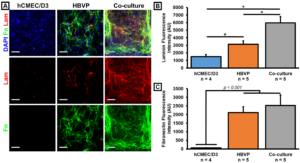
Introduction The blood-brain barrier (BBB) plays an important role in maintaining brain chemistry by restricting the permeability of small molecules and cells. Inflammatory diseases may disrupt the BBB and promote the development of neurological disorders [1]. One potential mechanism of…
Optimizing Cytomix Stimulation on Mono- and Coculture BBB Models

Introduction The µSiM BBB model is being developed at UR with the goal to understand the impact of sepsis on the brain. Here, we use an EECM-BMEC-like cell (iSPC-derived brain endothelial cells) [1] monoculture model and an EECM-BMEC-like cell and…
Merging Man with Machine: A Computer Vision Aided Leukocyte Transmigration Assay

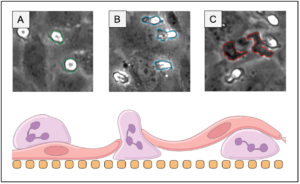
Introduction High throughput imaging techniques in conjunction with in vitro micro-physiological systems (MPS) allow for comprehensive exploration of physiologically relevant phenomena in a living 3D mimetic of a tissue microenvironment. Prior work in this lab has readily demonstrated that vascular…
Updates on Modeling the Vascular Basement Membrane in the μSiM-hNVU
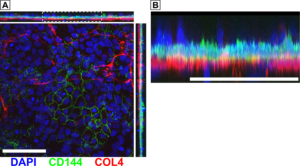
Introduction The blood-brain barrier (BBB) plays an important role in maintaining brain chemistry by restricting the permeability of small molecules and cells. Inflammatory diseases may disrupt the BBB and promote the development of neurological disorders [1]. One potential mechanism of…
Effects of TNF-alpha on iPSC-EC glycocalyx (EGL)

One of the validations of the in vitro human Blood Brain Barrier system is to ensure that the endothelial cells derived from iPSC’s and cultured in our system exhibit behaviors that are consistent with endothelial cell behavior in situ. The…
Posted in memBrains
Daily In-Situ Permeability using mouse CMECs

Introduction In the Glading Lab we study Cerebral Cavernous Malformations (CCMs). In CCMs, brain capillaries develop enlarged lumens and a disrupted blood-brain barrier. The presence of a mutation in KRIT1 causes loss of KRIT1 protein function in the endothelial cells.…
iPSC-derived Brain Pericyte-like Cells

Introduction Pericytes are mural cells that line the outer surface of microvessels and regulate diverse aspects of vascular development and function. We differentiate brain-pericyte-like cells (BPLCs) from hiPSC clones using the protocol published by Eric Shusta’s lab (Gastfriend et al.,…
Posted in memBrains
Culture divider insert assembly and test

Introduction We are designing a cell culture chamber insert to allow side-by-side co-culture of cells and ultimately triculture in the µSiM devices. Materials and Methods ALine devices assembly according to the “ALine Modular Device Assembly” instructions. 2-slot NPN membranes applied…
